There is a dangerous illusion sweeping through customer experience today. It is the illusion of progress.
Across boardrooms, AI demonstrations sparkle. Executives witness intelligent virtual agents resolving queries, voice bots navigating conversations with ease, and predictive systems guiding customer journeys with apparent precision. The promise feels immediate, and the future appears inevitable.
Yet beneath the surface, a quieter reality is unfolding, one that risks derailing the next wave of CX transformation before it even begins.
What we are witnessing is not yet an AI revolution. It is an epidemic of AI pilots.
Unless leaders confront the structural realities behind the hype, many organizations will find themselves trapped in perpetual experimentation—impressive in demonstrations, disappointing in production, and ultimately eroding confidence rather than creating value.
This widening gap between promise and reality is becoming the defining challenge for modern CX. It is the Trust Gap.
And it will separate the winners from the casualties of the AI era.
The Trust Gap Is Not a Technology Problem—It Is an Enterprise Problem
One of the most revealing patterns across customer operations is this: AI works brilliantly in controlled environments but falters spectacularly in live production.
Not because the models are weak, but because the enterprise is unprepared.
Many CX leaders assume that deploying conversational or agentic AI is fundamentally a technology decision. Yet mounting evidence shows that failures are rarely due to the models themselves.
They stem from fragmented knowledge, broken workflows, inconsistent processes, and legacy architectures that were never designed for intelligent orchestration.
Enterprise knowledge today is scattered across repositories, permission layers, and outdated formats. In many environments, support teams rely on multiple disconnected knowledge sources—often numbering in the double digits—creating systemic complexity that AI must navigate in real time.
This fragmentation introduces what can only be described as the integration tax: the unavoidable cost of preparing the enterprise for intelligence.
Here lies the uncomfortable truth: AI does not resolve operational chaos. It amplifies it.
When organizations deploy AI without addressing their underlying knowledge and process architecture, hallucinations increase, reliability declines, and automation initiatives collapse under the weight of their own ambition.
What began as a competitive differentiator becomes an operational liability.
The Real Shift: From Deflection to Autonomous Resolution
For years, the north star of customer service automation was simple: deflect tickets, reduce volume, drive customers towards self-service, and lower cost-to-serve.
That era is ending.
The emerging frontier is autonomous resolution—AI systems capable of executing tasks across enterprise systems, not merely suggesting answers.
This shift changes everything.
It transforms CX from a reactive function into an execution engine.
But autonomous resolution introduces a new level of operational risk. When AI moves from answering to acting—updating accounts, issuing refunds, and scheduling services—the tolerance for error collapses.
Customers may forgive a wrong answer, but they will not forgive a wrong action.
Organizations that underestimate this shift will face cascading consequences: increased escalations, higher ticket volumes, and reputational damage stemming from automation failures.
In the age of intelligent automation, reliability—not novelty—will determine enterprise survival.
Voice AI: The New Front Door of Customer Experience
While conversational chat has dominated recent discussions, voice AI is rapidly emerging as the next operational battleground.
Not because it is fashionable. Because it addresses the most persistent friction in CX—human time.
Voice-enabled AI systems increasingly act as invisible co-pilots during live interactions. They retrieve information in real time, anticipate customer intent, automate documentation, and guide agents through complex workflows—all while conversations are unfolding.
The implications are profound. Voice is no longer just an interaction channel. It is becoming an operational intelligence layer.
Organizations deploying advanced voice-enabled workflows are already reporting measurable productivity gains, reduced idle time, and faster resolution cycles.
Yet once again, technology alone is not the differentiator. Integration is.
Voice AI cannot operate effectively in fragmented ecosystems. Without seamless integration with CRM systems, knowledge repositories, and operational workflows, its promise collapses into latency, confusion, and poor customer outcomes.
And in customer experience, latency is not merely a technical flaw. It is a trust-killer.
The Coming Collision: Efficiency vs Trust
But efficiency alone does not ensure success.
In fact, the very capabilities that make AI powerful are also the ones that pose the greatest risk.
As AI capabilities scale, a more complex question emerges, one that goes beyond operational metrics. What happens when efficiency begins to outstrip trust?
AI systems increasingly learn from behavioral patterns, including preferences, sentiment, and interaction histories. This enables unprecedented levels of personalization. Conversations resume where they left off. Recommendations become predictive rather than reactive.
Customers feel understood until they feel watched. This is the paradox of hyper-personalization. Done well, it feels like memory; done poorly, it feels like surveillance.
Trust will become the central currency of the AI-driven enterprise, not speed, scale, or cost reduction. Yet trust is fragile.
After repeated failures—often as few as three poor experiences—customers abandon automation altogether, returning to human-assisted channels and driving costs back up.
The Hidden Risk: AI Will Reshape Workforce Logic Before Leaders Are Ready
Much of today’s AI conversation centers on technology, but the deeper disruption will occur within the workforce itself.
AI is not replacing agents; it is redefining them.
In the emerging operating model, every human interaction becomes both a service event and a learning loop. AI systems analyze conversational patterns, sentiment shifts, and resolution outcomes—transforming everyday interactions into operational intelligence.
This introduces a new form of workforce augmentation, not automation. Amplification.
Agents become orchestrators of intelligence rather than executors of routine tasks. Yet this transition demands something many organizations have not yet prepared for: behavioral transformation at scale.
Training programs designed for legacy workflows will not suffice. Leaders must redesign role definitions, incentive structures, and performance metrics.
Otherwise, technology adoption will outpace human readiness, and productivity will stall.
The Rise of Next-Generation Managed Service Providers
And this is precisely where many organizations encounter their greatest limitation—not technological capability, but execution capacity.
Amid growing complexity, a new category of enterprise partner is emerging.
Not traditional outsourcing providers. Not pure technology vendors. Something more deliberate and far more consequential. Next-generation managed service providers.
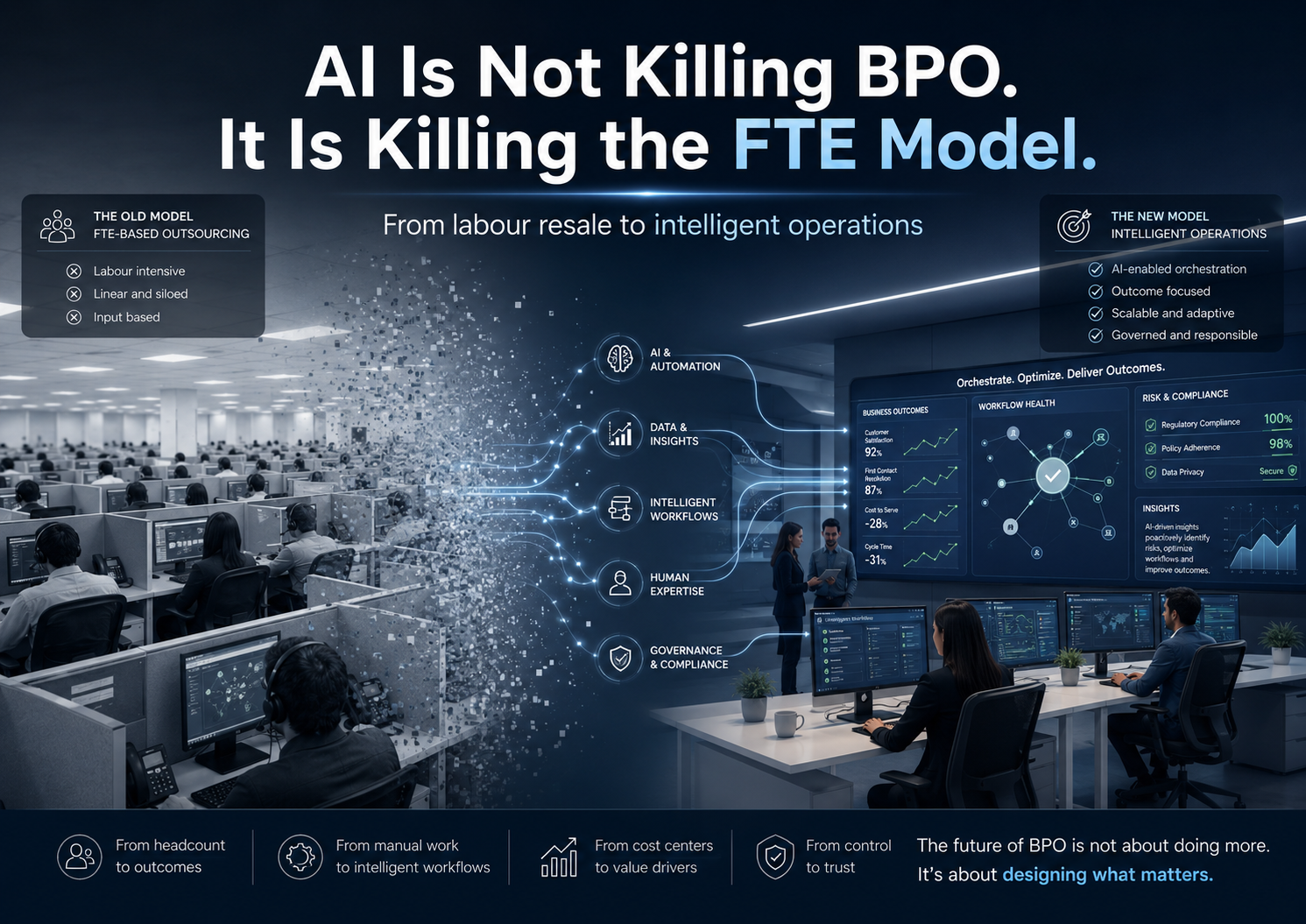
These organizations do not merely provide capacity. They provide capability orchestration: bridging strategy, CX operations, and execution across people, processes, and technology.
Their role is evolving into three critical interventions.
- Strategic alignment: helping organizations identify where AI creates meaningful value, not where hype suggests opportunity.
- Operational readiness: restructuring workflows, knowledge systems, and governance frameworks to enable intelligent automation.
- Technology enablement: deploying high-potential proof-of-value solutions to demonstrate measurable outcomes before scaling investment.
In the next phase of CX transformation, experimentation without orchestration will be indistinguishable from failure.
Possible Futures: The Paths Now Emerging
The future of customer experience will not follow a single path. Instead, several possible futures are already taking shape.
In one future, organizations invest heavily in AI pilots but fail to scale them to production. Costs rise. Benefits stall. Stakeholder confidence declines. CX remains fragmented. AI becomes synonymous with disappointment. This is the Automation Plateau, the default outcome for organizations that prioritize tools over transformation.
In a future, forward-thinking organizations redesign workflows around intelligence from the ground up. Knowledge becomes structured. Processes become adaptive. AI agents evolve into operational collaborators capable of executing complex, end-to-end tasks. CX shifts from reactive service to predictive resolution. This is the Autonomous Enterprise, where intelligence underpins operational design.
A third future is already emerging—one in which enterprises increasingly rely on strategic managed service partners to orchestrate transformation. Not because they lack ambition, but because the complexity exceeds internal capacity. In this Managed Intelligence Economy, transformation becomes a collaborative discipline, not an isolated project.
A fourth future is more troubling. Organizations deploy AI aggressively, yet without governance discipline. Customers encounter repeated failures, opaque decisions, and inconsistent experiences. Trust erodes. Regulatory pressure intensifies. Human-assisted service becomes a premium offering rather than the default. This is the Trust Collapse Economy, and recovery will prove far more expensive than prevention.
The Strategic Question CX Leaders Must Now Ask
The defining question is no longer: Should we adopt AI? That debate is settled.
The real question is far more confronting: Is our organization structurally prepared for intelligence?
Because the next phase of CX transformation will not reward speed alone.
It will reward preparation and discipline. Above all, it will reward leaders who recognize that AI is not a feature to deploy but an operating model to design.
In the coming years, every customer experience organization will deploy AI, but only a fraction will operationalize it successfully. The rest will remain trapped in demonstrations, forever showcasing innovation without delivering transformation.
History has shown this repeatedly. The organizations that win are not those that adopt technology first. They are the ones who build the foundations that enable technology to scale.
The defining challenge of the next decade will not be whether AI works. It will be whether leadership disciplines evolve quickly enough to make it work safely. In that race, operational readiness—not technological ambition—will determine who leads, who follows, and who falls behind.