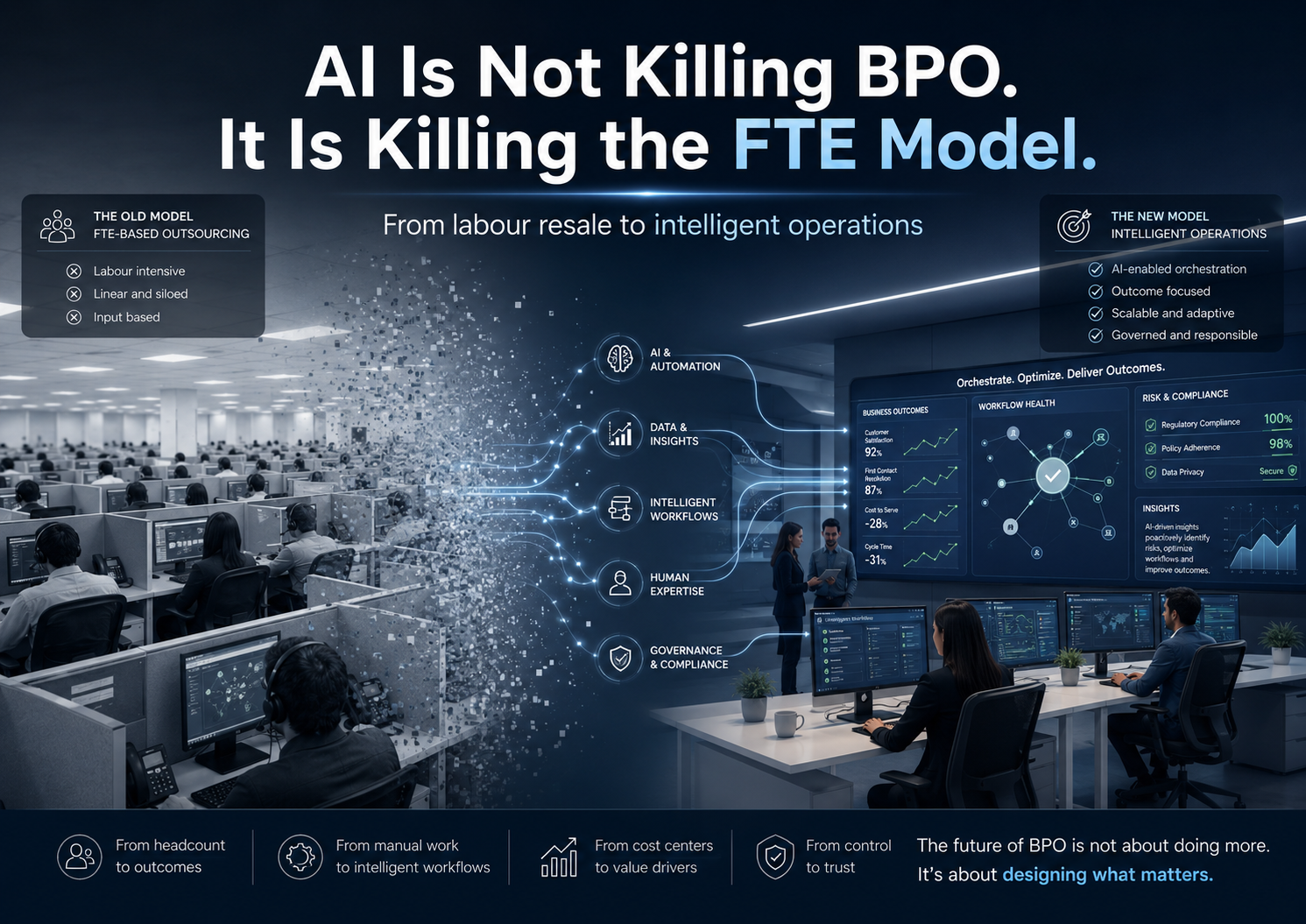
For years, the customer experience industry has measured progress by efficiency. Lower handle times. Higher containment rates. Faster responses. Lower cost-to-serve.
The modern contact centre and BPO industry was built on the assumption that scale, standardization, and process discipline would yield better customer outcomes.
Then AI arrived, seemingly offering the ultimate operational breakthrough: the promise of near-infinite conversational scalability and human-like fluency.
Yet beneath the excitement surrounding generative AI, agentic systems, and conversational automation, a more uncomfortable truth is coming to light.
Many organizations mistake conversational automation for transformation while leaving the underlying operational dysfunction untouched. That distinction matters enormously.
The next disruption in CX will not be defined by who deploys the most bots. It will be defined by who redesigns the organization around intelligence, orchestration, anticipation, and trust.
The Industry Is Moving Beyond “Should We Use AI?”
One of the clearest signals across the industry is that the AI debate has fundamentally changed.
The question is no longer whether AI belongs in customer operations. The question is now whether organizations can operationalize it effectively. That shift may seem subtle, but it changes everything.
In the first wave of AI adoption, many CX leaders treated automation as a technology experiment. Pilots were launched, chatbots were added, agent-assist tools were deployed, and innovation teams showcased proofs of concept.
But the latest generation of AI systems is revealing a deeper organizational problem: most enterprises were never designed for intelligent orchestration.
There is now a recurring tension across the market. Organizations want highly autonomous AI systems capable of resolving customer issues dynamically across channels, workflows, and departments. Yet beneath many operations lie fragmented data environments, disconnected workflows, inconsistent knowledge management, legacy governance models, and siloed ownership structures.
AI is exposing operational fragmentation that was previously concealed by human labour.
For decades, contact centers absorbed organizational inefficiency through people. Humans became the integration layer between disconnected systems, incomplete processes, and inconsistent policies.
AI changes that equation. Once intelligence is embedded in workflows, fragmentation becomes immediately visible, and visible fragmentation becomes a strategic risk.
The Most Dangerous Mistake in CX
Many organizations still approach AI implementation as a customer-service technology deployment.
That may prove to be the defining strategic failure of the first AI era in CX.
The emerging AI operating model is not simply replacing agents with bots. It is reshaping how customer operations function.
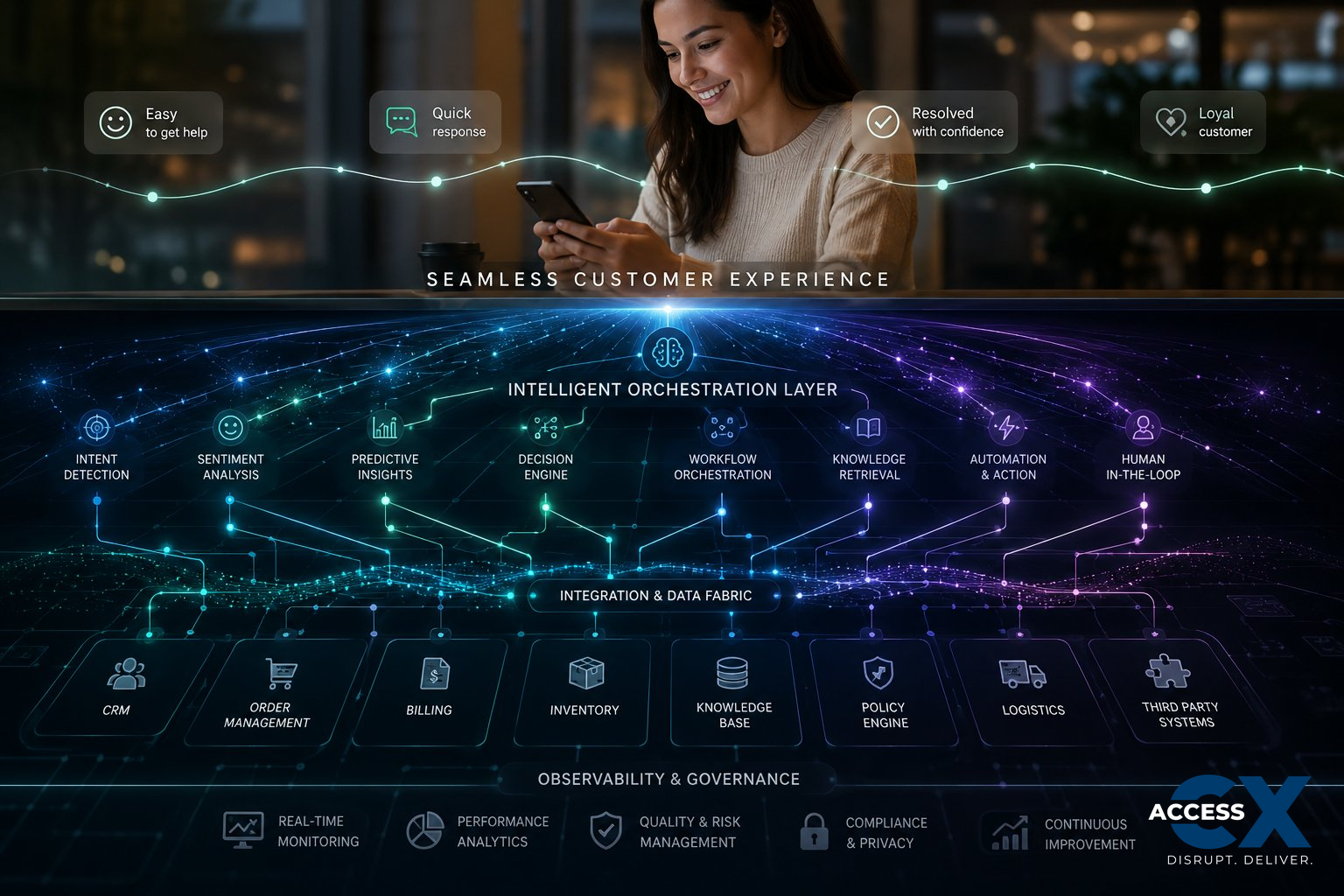
The most advanced conversations in the market no longer centre on chatbots alone. They increasingly focus on orchestration layers, agentic systems, observability, workflow integration, governance, proactive engagement, dynamic decision-making, and predictive operations. This is a profound shift.
The industry is shifting from interaction management to intelligence coordination.
The future contact center may no longer operate primarily as a reactive service environment. Instead, it increasingly functions as a real-time intelligence system that senses friction, predicts intent, orchestrates resolution paths, and coordinates interventions before customers escalate issues.
The economics of CX also shift fundamentally.
Historically, customer service was seen as a cost center because organizations prioritized efficiency over impact. Average handling time mattered more than customer confidence. Ticket closure mattered more than friction reduction. Containment mattered more than trust.
Proactive intelligence changes that equation.
If organizations can identify moments of customer confusion before escalation, detect operational anomalies before complaints arise, and dynamically coordinate resolution workflows in real time, the customer experience moves far closer to revenue protection, retention, and growth.
That is not customer service optimization. It is operational transformation.
The Rise of the Invisible Contact Center
One of the most important ideas now emerging is that the future of CX may become increasingly invisible.
The traditional contact center model relied on customers initiating interactions only after something had gone wrong. However, the next generation of AI-enabled CX environments is moving towards proactive intervention.
Systems are increasingly capable of detecting behavioral signals, friction points, delays, abandonment patterns, failed workflows, sentiment shifts, and operational anomalies before customers formally raise issues. This fundamentally changes the role of customer operations.
The future competitive advantage may not belong to organizations with the best chatbot.
It may belong to organizations whose customers encounter fewer friction-driven support moments, as intelligent orchestration continuously removes operational friction in the background. This has significant implications for BPOs and managed service providers.
Traditional outsourcing models were built on labour arbitrage and economies of scale. However, AI increasingly compresses the economic value of commoditized transactional work.
As automation absorbs repetitive interactions, the remaining value shifts towards orchestration, governance, workflow redesign, operational intelligence, and transformation capability.
The industry is approaching an inflection point at which next-generation managed service providers may become strategic transformation partners rather than transactional outsourcing vendors.
That represents a radically different positioning model.
Why Many AI Programs Will Stall
One of the most overlooked realities in public AI narratives is that enterprise-scale AI is far more operationally challenging than most organizations expected.
The challenge is not simply deploying models. The challenge is trust.
Agentic systems require access to enterprise workflows, customer data, decision logic, operational systems, and transactional capabilities. As AI evolves from information retrieval to autonomous action, governance complexity increases dramatically.
Enterprises are now facing difficult operational questions about governance, dynamic permissions, workflow evaluation, escalation thresholds, hallucination management, orchestration security, and business guardrails.
Most importantly, who within the organization owns the answer?
These questions reflect a growing recognition that AI transformation is not primarily a technology challenge. It is an organizational design challenge.
That is why many enterprises remain trapped between successful pilots and scalable deployment. They are attempting to automate workflows that were never operationally coherent to begin with.
The New Strategic Role of CX Managed Services
This is precisely where next-generation CX managed service providers become strategically important.
The traditional outsourcing relationship is no longer adequate in the AI era. Organizations increasingly require partners capable of bridging strategy, CX operations, workforce redesign, governance, process optimization, data readiness, and technology orchestration.
This means that future-focused CX partners must operate across multiple dimensions simultaneously and understand the operational realities of contact centers and BPO environments.
They must redesign workflows around intelligent orchestration. They must help organizations identify high-value AI use cases that deliver measurable business outcomes quickly. They must also bring proof-of-value AI solutions that demonstrate impact without forcing enterprises into multi-year transformation paralysis.
At the same time, they must help clients modernize governance structures, workforce models, escalation frameworks, observability layers, and operational processes, as well as the technology itself.
Most importantly, they must help organizations move from experimentation to operationalization. That requires a fundamentally different partnership. The future MSP may increasingly resemble an intelligence transformation layer positioned between enterprise strategy and operational execution.
Not a staffing vendor.
Not a software reseller.
Not a consulting slide factory.
But an operational transformation partner capable of continuously integrating people, processes, technology, and AI capabilities into a functioning CX ecosystem.
The Future of CX Will Be Coordinated, Not Automated
The most important lesson from the AI transition is that the industry may still be framing the discussion incorrectly.
The future of CX is not fundamentally about automation. It is about coordination.
Coordinating intelligence across fragmented systems.
Coordinating workflows across departments.
Coordinating proactive interventions across channels.
Coordinating human judgement with machine capability.
Coordinating governance with autonomy.
Coordinating operational efficiency with trust.
This is a far greater transformation than deploying conversational AI alone.
The contact center is quietly evolving from a labor-intensive operating model to an intelligence system. Many organizations are far less prepared for that transition than they realize.
The real disruption is not that AI can now talk to customers. The disruption is that AI is beginning to expose which organizations were never operationally coherent.
The organizations that succeed in the next era of CX will be those capable of redesigning themselves around coordinated intelligence before operational fragmentation becomes visible to customers, employees, and the market.