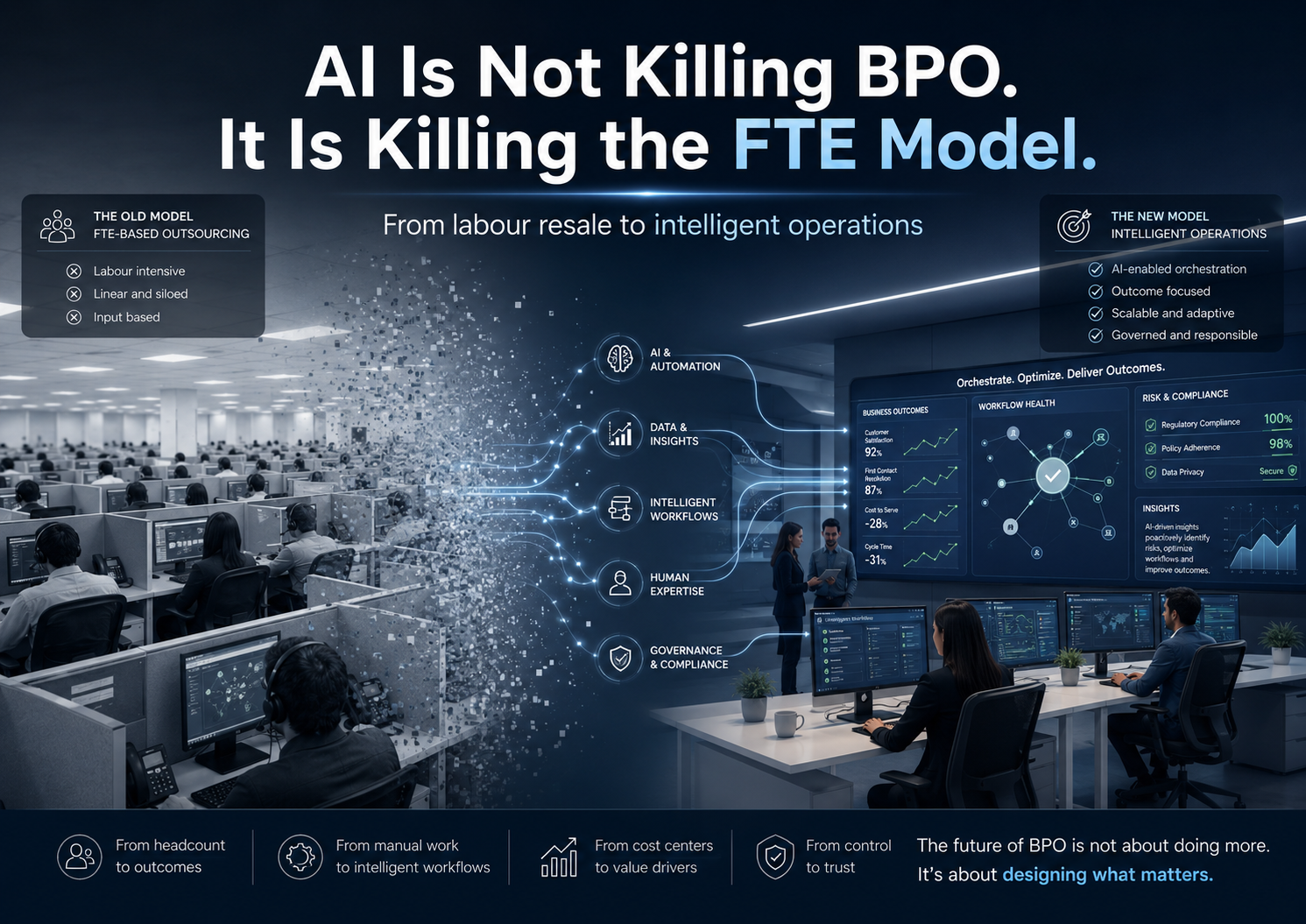
The Unseen Line the CX Industry Has Already Crossed
There are times in business when an entire industry crosses an unrecognized threshold. The web era was one of those defining moments. Cloud computing was another.
However, in current discussions about CX and operations leadership, a different kind of shift has begun—one that no longer concentrates on new channels or platforms. This time, the change is more substantial, structural, and irreversible. The transition is from systems that merely execute to systems that think.
Throughout discussions shaping industry dialogue, a pattern has emerged. Leaders no longer see AI as a mere curiosity or a disruptive force on the horizon. Instead, they describe it as a pivotal moment similar to the creation of the web: a transformation that will fundamentally change how service experiences are designed, delivered, managed, and understood.
AI is no longer simply another tool layered into a complex stack. It signifies a new approach to how customer experience will operate.
Yet, despite this urgency, many organizations still act as if there is unlimited time. They plan for restructuring in the distant future. They postpone data cleaning until later. They run internal pilots without genuine intention to expand them.
They discuss AI transformation in an abstract way, as if the industry will kindly pause until they are ready. But the signals emerging across today’s CX landscape make it clear that AI has already shifted from the sidelines to the centre. It is not waiting for anyone.
When Systems Begin to Think, Not Just Execute
For decades, the contact centre relied on a simple approach that made sense in a less complex world: as complexity increased, more staff, processes, and systems were added to handle the demand. That logic is now outdated.
Human capacity—regardless of how skilled, trained, or supported—cannot match the volume, variability, and speed of today’s customer expectations.
What becomes clear is that the next chapter of CX isn’t simply about automation. It is about intelligence. The most forward-thinking leaders now see AI agents not just as advanced chatbots but as entities with decision-making abilities—systems capable of interpreting behavior, understanding sentiment, detecting patterns, coordinating actions, and learning continuously.
The real challenge of AI, as one industry voice noted, is no longer orchestration; it is managing emerging intelligence. That difference changes everything because it indicates a shift from process automation to cross-journey cognition.
This is where the next competitive frontier lies. Future service experiences won’t just be faster or cheaper; they will be more anticipatory, more emotionally attuned, and considerably more intuitive.
Just as streaming platforms redesign the digital environment based on who you are rather than what you last clicked, AI-driven CX will start to shape journeys in ways that feel natural, human, and deeply personal.
Customers are increasingly seeking experiences where friction vanishes before they notice it, where problems are resolved silently, and where the brand seems to instinctively know what to do next.
The End of the Human-Bandwidth Era
This level of intelligence challenges organizations that were never originally designed to handle it.
Leaders often speak passionately about hyper-personalization, intelligent routing, or autonomous journeys, but the infrastructure supporting these ambitions tells a different story.
The systems supporting most contact centers today—knowledge bases, workflows, legacy CRMs, routing trees, training scripts—were designed for repetitive labour, not adaptive intelligence.
The gap between aspiration and capability continues to widen each quarter. AI’s potential is growing rapidly, but operational readiness is only improving slowly. As this gap increases, risks accumulate. However, the answer is not to replace humans.
Customers still favor human interaction for emotionally nuanced or complex issues. They actively welcome AI when it minimizes friction, guides them, or resolves hidden problems. However, they expect humans to offer trust, judgment, and reassurance.
The future, therefore, does not involve a conflict between humans and machine services. Instead, it presents a hybrid model where humans and AI collaborate seamlessly in an interdependent relationship.
AI interprets sentiment, generates insights, and manages routine complexities. Humans act as strategic enhancers, relationship-builders, and guardians of trust.
This is where the industry now faces its greatest divide.
The Intelligence Gap: Where AI Speeds Ahead and Organizations Stall
This emerging landscape presents a significant opportunity—and obligation—for a new type of partner.
Historically, call centers and BPOs focused on expanding staff and managing processes. However, the next-generation managed service providers (MSPs) will go beyond simple labour arbitrage.
Call centers and BPOs must evolve into capability multipliers, integrating strategy, operational design, talent development, trusted data foundations, and modular AI solutions in ways that internal teams cannot accomplish alone.
Supporting leaders in handling behavioral, cultural, and operational changes related to intelligent systems is crucial. This requires promoting transformation at a structural level, not just a technological one.
Providing proof-of-value modules that demonstrate impact prior to organizations committing to full-scale change is crucial. And next-generation MSPs must do this whilst maintaining deep expertise across people, process, and machine intelligence.
This isn’t about outsourcing as we traditionally understood it. It’s about enabling organizations to transition from operational maintenance to intelligence-driven evolution.
Leadership at the Crossroads of Tomorrow
The biggest risk to CX leaders today is not AI. It is passive leadership—leadership that assumes it can wait, believes the industry will slow down, and trusts that incrementalism will be enough.
The organizations that succeed in the next era will be those that recognize that intelligence is now the key currency in CX. They will reimagine processes to prioritize intelligence over labour.
They will form teams capable of making decisions rather than merely handling tasks. Moreover, they will work closely with capability builders who can unify strategy, operations, and technology into a seamless transformation journey.
The revolution has already begun. It does not announce itself and will not wait for the next budget cycle. Nor will it pause for organizations still viewing AI as a future project.
AI has already transformed the rules of customer experience. The only question now is which organizations will adapt themselves.