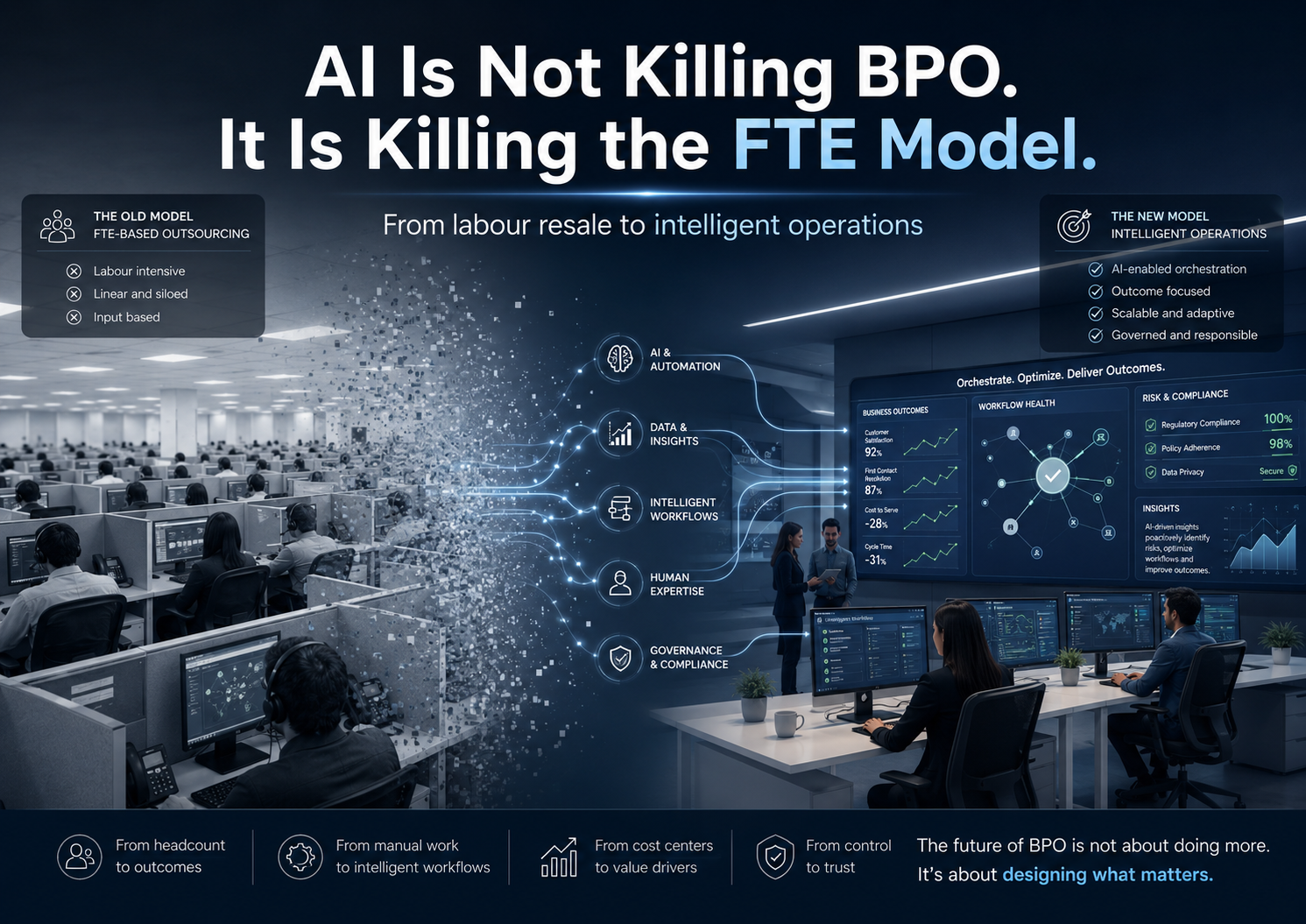
By 2026, customer experience will no longer be defined by how much AI an organization deploys—but by what it consistently delivers.
Most enterprises will report “AI in CX.”
Far fewer will operate AI-native CX models capable of producing measurable outcomes at scale.
This marks a structural shift in the industry:
CX is moving from automation to experience engineering.
What’s driving the change isn’t technology availability—it’s executive accountability. Boards are no longer funding experimentation without impact. The question has shifted from “Where is the AI?” to “Where is the value?”
Six forces are reshaping CX operating models:
- From interactions to outcomes
- From tools to orchestration
- From scripted automation to agentic execution
- From capacity management to demand suppression
- From individual agents to human-AI teams
- From speed as a metric to trust as a design principle
The implication is clear:
CX success in 2026 will be defined less by efficiency gains and more by repeatable, trusted business results.
Organizations that engineer CX for outcomes will pull ahead.
Those that only layer AI onto legacy models will struggle to close the gap.
Explore what AI-native CX really requires – Click to Download the PDF