For years, the voice channel was expected to die.
Customers were encouraged to use apps, websites, FAQs, chatbots and IVRs. Digital transformation promised to shift demand away from the phone to lower-cost channels.
Yet the phone remained.
Not because customers rejected digital, but because the phone became the place where broken journeys were rescued. When the app failed, the chatbot looped, the claim stalled, or the answer was buried across fragmented systems, the customer called.
The contact centre survived because it became the recovery mechanism for everything else. That is why voice AI matters.
The disruptive question is not whether AI agents can answer calls more cheaply than humans.
Voice AI exposes the weaknesses contact centers have long absorbed: failed journeys, inconsistent knowledge, disconnected systems, and the human effort required to compensate for poor organizational design.
Voice AI Changes the Question
The first wave of service automation was framed around containment and deflection: how many calls can we avoid, how many customers can we redirect, and how much cost can we eliminate?
Voice AI reframes the question. The issue is no longer “How many calls can we automate?” It is “Why were these calls necessary?”
A routine call is rarely just a transaction. It is often a signal. It may reveal poor communication, a confusing product, a broken process, weak digital design, missing notifications, or failure to resolve the issue first time.
In a traditional operating model, these signals are diluted by volume. Calls arrive, queues build, agents respond, staffing models are adjusted, and improvement initiatives compete for attention.
Voice AI offers a different possibility. Every conversation can become structured intelligence. Every repeated question can expose an upstream failure. Every escalation can reveal the boundary between automation, process and judgement.
The winners will not simply replace human conversations with synthetic ones. They will use voice AI to understand the architecture of demand.
The End of Volume-Based Comfort
For decades, volume has been the organizing principle of the contact centre.
Forecast it. Staff to it. Reduce handling time. Improve occupancy. Manage service levels. Negotiate BPO contracts based on seats, hours, transactions, or calls.
This logic is becoming strategically inadequate.
When voice AI agents can handle routine demand at scale, call volume ceases to be a neutral operational fact. It becomes evidence of friction, avoidable effort, process failure, and unmet need.
A spike in calls should not only trigger extra capacity. It should prompt a harder question: what has gone wrong in the journey?
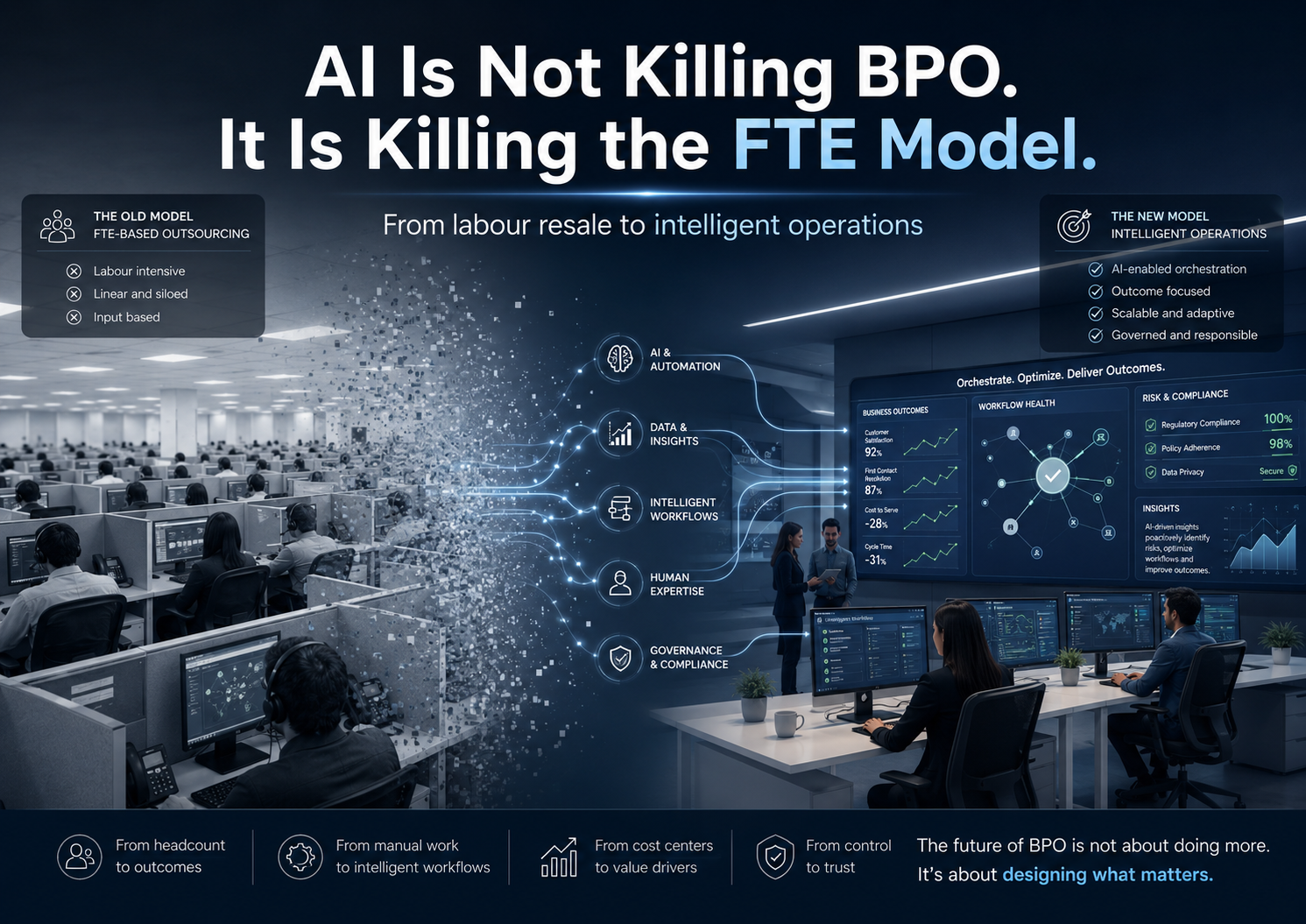
This matters for BPOs. Traditional BPO economics have often been linked to the efficient handling of high-volume work. But if more of that work can be automated, avoided or redirected, the basis of value shifts. Operational excellence remains important, but it is no longer sufficient.
The BPOs most at risk may not be the weakest operators. They may be the efficient operators whose value remains tied to demand that AI will increasingly absorb, reroute or eliminate.
The Contact Centre Becomes the Trust Layer
Voice AI does not remove the need for humans. It changes where human value lies.
As AI agents take on routine tasks, the human role shifts towards exception handling, judgement, empathy and recovery. The contact centre becomes less of a transaction engine and more of a trust layer.
That sounds attractive, but it carries a hidden risk. If organizations automate simple tasks and leave humans with only the most complex, emotional or high-risk interactions, frontline roles become more demanding, not easier.
Agents will need better context, authority, training and support. They will need to interpret AI summaries, challenge recommendations, manage vulnerable customers, resolve edge cases and restore trust when automation fails.
The future contact centre cannot be designed around script compliance alone. It must be designed around decision quality. Leaders will need to monitor agent behaviour, AI accuracy, escalation quality, recovery effectiveness, compliance, and human-AI handoffs.
The most important handover may not be from digital to voice, but from automation to accountability.
BPOs Face a Strategic Reset
Voice AI challenges the traditional hierarchy of BPO value.
Labour arbitrage, scale, recruitment capability and process discipline will still matter, but they will no longer define market leadership.
Clients will increasingly ask whether partners can identify which demand should be automated, redesigned, or removed; manage AI and human operations together; improve the journey rather than simply handling its failures; and demonstrate value before scaling technology.
The BPO of the future will need to become an intelligence orchestrator, combining operational delivery with analytics, journey redesign, AI governance, workforce transformation and continuous improvement. It will need to help clients shift from activity-based to outcome-based metrics.
That is a very different proposition from “we can handle your calls at a lower cost”.
Proof of Value Before Scale
The danger now is that voice AI becomes another technology rush.
A voice AI agent that performs well in a controlled demonstration proves very little. The real test is whether it can operate in live service conditions: real customer language, interruptions, ambiguity, system integration, secure authentication, clean escalation and error recovery.
This is why proof of value matters more than proof of concept.
The right starting point is not the technology. It is the use case. Leaders should identify where voice AI can deliver measurable value, including missed-call recovery, appointment confirmation, payment reminders, routine servicing, lead qualification, status updates, follow-up or triage.
Each use case should be tested against operational reality. Which customer problem are we solving? Which systems need to be integrated? What level of autonomy is acceptable? When should a human intervene? What risk controls are required?
The goal is not to scale AI quickly. It is to scale confidence.
The Rise of the Next-Gen Managed Service Provider
This is where the next generation of managed service providers becomes strategically significant.
The traditional MSP model was often associated with infrastructure, support, outsourcing or technology management. The next-gen MSP must play a different role: bridging strategy, CX operations and execution across people, processes and technology.
It must help leaders move from ambition to adoption, from experimentation to evidence, and from vendor selection to managed transformation.
In the voice AI context, this means helping organizations assess operational readiness, map friction in the journey, redesign processes, prepare frontline teams, select high-potential proof-of-value solutions, manage implementation, monitor outcomes, and support continuous optimization.
Many CX leaders are caught in the missing middle. Strategy sees the potential. Technology sees the integration challenge. Operations sees the pressure. Frontline teams see the reality. Vendors see the use case through their product’s lens.
The next-gen MSP becomes the neutral orchestration layer that aligns these perspectives around measurable CX value.
Exposure Before Advantage
Voice AI will not make CX simpler. It will make weak CX harder to hide.
It will reveal whether the enterprise understands its customer journeys or merely reacts to demand. It will reveal whether the contact centre is an intelligence source or a cost centre under pressure. It will reveal whether BPO partners are creating value or simply processing volume.
For CX, call centre and BPO leaders, the mandate is clear. Do not start with how many calls can be automated. Start with why customers are calling, what work needs to be done, where trust is created or lost, and where human judgement matters most.
The future will belong to those who redesign their operating model around intelligent orchestration.
Voice AI will reveal whether the enterprise has a CX operating model, or merely a contact-handling machine.