Access CX

Automation

From Contact Centres to Cognitive Enterprises: The Quiet Collapse of an Operating Model

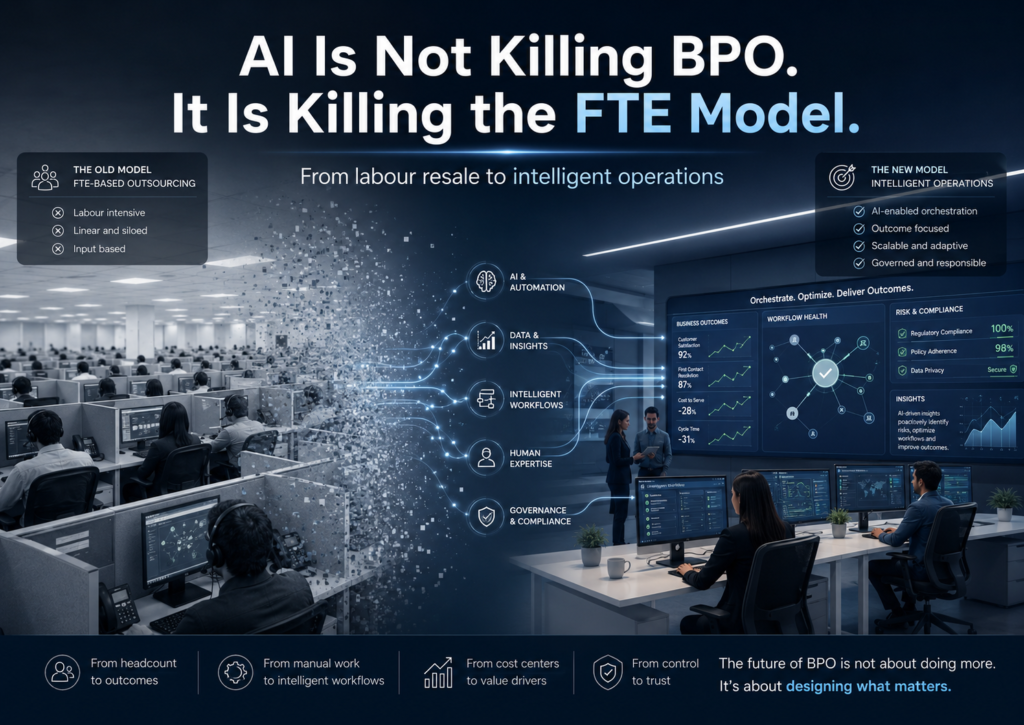
For more than four decades, the contact centre has been engineered as an industrial machine. Forecast demand. Optimize schedules. Script interactions. Measure handle time. Contain costs. The human agent was positioned as both interface and engine—absorbing variability, resolving exceptions, and bearing the emotional burden of scale. AI was first welcomed into this world as a tool. Automation to handle volume. Analytics to improve reporting. Bots to shave seconds. But something far more destabilizing is now unfolding. The contact centre is no longer being augmented. It is being cognitively re-architected. What is emerging is not a smarter stack of tools but a different class of system altogether—one in which interaction handling, workforce orchestration, quality assurance, performance coaching, and experience optimization converge into a continuously learning whole. Not software. Operating intelligence. Once cognition enters the core, the contact centre ceases to be a function. It becomes a sensing organ within the enterprise nervous system. Nervous systems do not optimize cost. They shape behavior. The End of Reactive Service Most service environments are still structured around lag. Customers act. Systems respond. Leaders analyze what has already happened. Agentic AI collapses that sequence. When every interaction is interpreted in real time, when sentiment is continuously modeled, when demand is forecast behaviorally rather than historically, and when next-best actions are dynamically generated, service stops being a response mechanism and becomes predictive. This is the quiet shift from customer service to customer choreography. In such a model, interactions are no longer isolated events. They are signals in motion. Each conversation updates the organization’s understanding of risk, intent, effort, emotion, and opportunity. Each moment feeds into routing, experience design, workforce planning, and even product and policy logic. The contact centre becomes less like a queue and more like a sensing organ. Strategically, this challenges one of the deepest assumptions in CX and BPO: that service scale must be paid for with human variability. When cognition is embedded in the operational flow, variability itself becomes something the system learns from—not something leaders merely absorb. This is where service stops being a cost structure and becomes an adaptive capability. The Disappearance of the “Average Agent” One of the least discussed consequences of this shift is the erosion of the middle. When systems can observe, interpret, guide, coach, and quality-assure every interaction, the notion of an “average” agent becomes structurally irrelevant. Performance is no longer sampled; it is continuously shaped. This creates a bifurcation. On one side, routine interaction handling increasingly shifts to machine-led flows. On the other, human roles move upwards into judgement, exception handling, emotional resolution, ethical discernment, and complex orchestration. What begins to disappear is the large middle tier of semi-scripted labour that defined traditional call centers and fueled the BPO scale model. This is not primarily about workforce reduction. It is a workforce phase-change. The strategic question for leaders is no longer “How do I automate calls?” It is: what is the future economic role of human capability in a system that can already perceive, decide, act, and learn? The organizations that answer this early will redesign talent architectures, incentives, and operating rhythms to leverage humans rather than rely on human volume. Those that delay will find themselves running increasingly sophisticated platforms with progressively thinner human meaning. Three Futures Emerging from the Same Technology What makes this moment strategically dangerous is that the same underlying capabilities can yield radically different futures. In one future, enterprises double down on efficiency. They build near-autonomous service engines optimized for throughput, containment, and cost extraction. CX becomes technically impressive yet emotionally thin. BPOs become infrastructure utilities. Trust becomes fragile. Differentiation erodes. In a second future, service functions evolve into adaptive experience systems. AI handles scale, while humans are deliberately redeployed into higher-order roles: behavioral insight, relationship repair, contextual judgement, and cross-functional sense making. Here, CX becomes a strategic intelligence function. Contact centers become experience laboratories. BPOs become co-design partners. In a third, more disruptive future, the contact centre dissolves as a category. Cognitive service capabilities are embedded across the enterprise—within products, operations, risk, and ecosystems. Interaction is no longer a place customers go. It is something the organization continuously delivers. Which future unfolds is not determined by technology. It is determined by who architects the operating model. Why Next-Generation Managed Service Providers Will Shape the Outcome Traditional managed services were designed to absorb labour, standardize processes, and enforce operational discipline. That model is misaligned with current requirements. The emerging environment demands partners who can operate across three planes simultaneously. Strategic: helping leaders redesign service not as a function but as a behavioral and economic system—integrating it into enterprise strategy, growth logic, and risk posture. Operational: re-engineering CX environments to operate as learning systems, where workflows, roles, and governance continuously evolve as cognitive capability expands. Technological: rapidly standing up high-potential, proof-of-value AI solutions that are not left as pilots but deliberately engineered as operational building blocks—embedded into workforce planning, interaction handling, quality systems, and decision flows. This is not IT outsourcing. It is operating-model co-creation. The managed service provider of the next decade will not primarily sell seats, scripts, or software layers. It will provide translational capability: converting emerging AI potential into institutional practice across people, processes, and technology. They will sit between ambition and execution, between boards and operations, between models and moments. Critically, they will own not just delivery but also design responsibility. The Strategic Risk Leaders Are Underestimating Most CX and BPO strategies still assume the future will be an extension of the past: more channels, smarter bots, better analytics, leaner operations. The evidence points elsewhere. When systems can orchestrate demand, interpret emotion, assure quality, coach performance, and recommend action as an integrated whole, the unit of competition shifts. It is no longer the contact centre. It is the enterprise’s capacity to learn from interaction. Those who industrialize that capacity will move faster than markets, not just respond to them. Those who do not will optimize a structure that no longer confers an advantage. The provocation for

From Contact Centres to Cognitive Enterprises: The Quiet Collapse of an Operating Model Read More »

Agenitic

The Agentic Revolution: Redefining Customer Experience and the Future of Call Centers

The customer service landscape has undergone its most significant transformation in decades.  The industry has evolved through gradual automation, self-service, and advancements in digitization. However, the emergence of agentic AI—a new wave of AI systems capable of planning, reflecting, collaborating, and leveraging tools—indicates a disruptive leap forward.  These AI agents do not just respond to queries; they think, refine, and take action. They are more than basic digital tools; they are evolving into digital teammates. For CX executives and BPO leaders, this is more than just a technical upgrade; it represents a paradigm shift that necessitates a re-evaluation of strategy, operations, and managed services. From Automation to Orchestration Traditional automation in call centers has focused on eliminating human effort: IVRs, scripted bots, and RPA have been the tools of the trade. However, they often fall short when complexity, emotion, or unpredictability enters the equation. Agentic AI changes the game. These systems can interpret unstructured inputs, plan a series of actions, utilize APIs and tools autonomously, and even collaborate with other agents or humans in real-time. In this new world, the goal is not only to reduce costs through automation but also to create value. Imagine a future where AI agents triage inbound contacts, initiate complex workflows, and engage human agents only when judgment, empathy, or high-stakes escalation is required. The contact centre transforms into an intelligent network of human and AI collaboration. However, as we embrace agentic capabilities, it is vital to distinguish between augmentation and autonomy. Economist Daron Acemoglu warns that the promise of AI agents lies in their ability to advise, rather than decide unilaterally. In customer-facing roles—where empathy, ethics, and human nuance are deeply significant—CX leaders must ensure that humans retain the final say in high-impact decisions. This is not merely a compliance measure but a design principle that reinforces trust, responsibility, and fairness. Operationalizing Agentic CX CX leaders must adapt their operating models to fully leverage the potential of agentic AI. Rapid experimentation is essential for innovation. Generative AI significantly reduces the time required to prototype new support flows, knowledge interfaces, and escalation strategies. What once took months can now be created, tested, and improved in just days. This agility transforms product launches, policy changes, and even seasonal surges. Second, evaluation becomes the primary bottleneck. In an agentic world, the challenge extends beyond deployment to encompass trust. Can the AI be trusted to adhere to compliance rules, represent the brand tone, and manage edge cases? Continuous evaluation pipelines, human-in-the-loop systems, and robust simulation environments will become standard practices in high-performing CX operations. Third, orchestration layers are emerging as the new middleware. Platforms like LangGraph and Landing AI’s Vision Agent exemplify this shift; they enable dynamic workflows that integrate language models, APIs, databases, and human agents in cohesive cycles. This signifies a new tech stack for enhancing customer experience. A significant change in infrastructure supports this shift. Platforms such as UiPath’s Automation Cloud are evolving to assist not only with automations but also with the entire lifecycle of agentic agents: from design to deployment, monitoring, compliance, and scaling.  CX organizations must look beyond standalone AI features and invest in cohesive platforms that ensure observability, secure orchestration, and integrated governance across multi-agent environments. People and Process in the Age of AI Teammates Agentic AI does not replace people; it redefines their roles. Frontline agents evolve into orchestrators, auditors, and exception handlers. Their soft skills—empathy, negotiation, and reassurance—are enhanced rather than diminished. Training programs should now incorporate prompt engineering, AI oversight, and escalation choreography. Middle management will transition from workforce scheduling to overseeing AI-agent performance and fostering cross-agent collaboration. Processes must adapt to the new hybrid reality. Standard operating procedures are becoming more fluid, driven by feedback loops from AI outputs, customer responses, and human interventions. KPIs are evolving: we are beginning to track resolution quality, iteration depth, and agent efficiency—not only AHT or CSAT. Agentic AI introduces a new digital management layer. These agents operate more like managers than bots, dynamically coordinating tools, APIs, data, and human input to deliver results. In CX, this redefines service orchestration into AI-led workflow governance—where agents initiate actions, escalate intelligently, and adapt based on context. The enterprise no longer merely executes automation; it manages a workforce of AI collaborators. The Future of Managed Services For BPOs, agentic AI presents new opportunities for value creation. The traditional labour arbitrage model is being replaced by a hybrid delivery model that integrates AI agents into the managed service offering. Smart BPOs will create proprietary workflows designed for specific industries, such as insurance claims processing, telecom troubleshooting, and financial onboarding. These workflows will become essential to their intellectual property and unique differentiation. Clients will not merely purchase seats or SLAs; instead, they will gain access to orchestrated and continuously evolving AI-powered service ecosystems. This creates new revenue streams but also poses governance challenges. Who will train the agents? Who owns the data? How can we ensure responsible AI across different jurisdictions? Managed service contracts must address these questions at their core. Several Possible Scenarios Could Unfold Looking forward, several scenarios could arise: Strategic CX leaders will prepare for various potential futures. They will invest in agile experimentation, strong governance, and adaptable talent models to respond to any trajectory that may unfold. Final Thought Agentic AI is more than just a technological trend; it signifies a systemic shift influencing strategy, operations, personnel, and technology. In the call center and BPO sector, it offers an opportunity to go beyond the confines of linear improvement and adopt exponential reinvention. The future of CX relies not just on human efforts or AI capabilities, but on the intelligent, orchestrated collaboration between both. The focus has shifted from whether AI will transform the call center to who will lead this transformation. Critically, the era of isolated AI pilots is ending. The next chapter involves strategic, scalable, and responsible adoption. CX leaders must act as orchestrators—balancing innovation with governance, speed with safety, and digital autonomy with human-centric values.  Winners will not be

The Agentic Revolution: Redefining Customer Experience and the Future of Call Centers Read More »